Reverse Engineering: Design Across the Curriculum

Most of us know how project-based learning can revitalize school by putting students face to face with authentic challenges, coming up with their own solutions to problems faced by real people in the real world. 


But a lot of school content gets left out of this approach. You don’t need an understanding of the American Revolution or The Bluest Eye or the periodic table in order to make the local park more accessible or write a letter to the city council. So these subjects get left out of this more authentic learning, and end up getting taught pretty much like they always have been.

What if we didn’t? How could we teach this more traditional content like we teach PBL, in a way that puts students inside the works they’re studying, tackling problems like those the poet or the chemist or the representative to the constitutional convention tackled? How might we invite them inside these problems—so they can understand the trade-offs they faced, the design choices they made and the logic behind them, the alternate paths they could have followed

What if we change the way we think about the stuff those courses are made of? Not as a body of knowledge that was figured out a long time ago, textbooks full of stuff our kids need to get into their heads—but as the tracks left by ordinary people coming up with the best solution they could build to the challenges they faced. Which is, of course, what it actually is. Because most of school tries to fake us out. Takes the contingent mess of what actually happened (the wandering paths traveled by real people trying to figure out how to make things work), cleans them up, smoothes them out, and organizes them into numbered chapters. As though the painting on the wall or the poem on the page is the only one Picasso or Angelou could have made, and all that’s left for sts  is to learn how to admire it properly. 

What would it look like to reverse engineer the curriculum? What if we brought design’s skillset, mindset, and process to everything we do in school? 

I learned to think of a picture not as a finished product exposed for the admiration of virtuosi, but as the visible record…of an attempt to solve a definite problem in painting, so far as the attempt has gone. I learned…that no ‘work of art’ is ever finished….Work ceases upon the picture or manuscript, not because it is finished, but because sending-in day is at hand, or because the printer is clamorous for copy, or because ‘I am sick of working at this thing’ or ‘I can’t see what more I can do to it.’

R.G. Collingwood, An Autobiography (1932)

Maybe we’d turn the experience of learning this stuff into something like the experience of the people who discovered it. Put students face to face with the problem the colonist or the chemist or the poet faced and challenge them to figure out their own solution to it—and thereby understand that problem intimately. Then evaluate the solution this earlier person came up with, the way they handled the hard parts of the problem; how they balanced its trade-offs; how the place they were coming from (their personality, context, values, vocabulary) shaped the design choices they made—and how they framed the problem before them. 

Not too human: What AI tutors could learn from Steve Austin

In the opening credits for the Six Million Dollar Man, we watch an astronaut crashing at lift-off, and hear how his life might be saved by replacing his broken body with bionic limbs. “We can rebuild him….[M]ake him better than he was. Better…stronger…faster.

The same thrill runs through the voices of those who see in AI, the chance to build a virtual tutor better than any human: smarter, faster, able to remember every answer — and respond with instant feedback, over and over again.

And strangely enough, this same vision of the future — though tinged with dread — also comes from those who warn against the rise of virtual tutors. Both supporters and skeptics can only imagine an AI tutor that’s trying to be human. The future they picture is their favorite teacher, supercharged; smiling warmly from the folds of a worn cardigan.

But why aim so low? Before we reach a future full of AI tutors, we need to get clearer on what makes a good one. Why build a cyborg-tutor in our own image…when we could build a robot that could be anything we imagine? Why not sidestep the paradigm of a human tutor — and the box it keeps us thinking in — to envision a truly ideal learning experience?

The writers of the Six Million Dollar Man needed to make Steve Austin feel like a familiar action hero. They could make him better, but they had to keep him human. They could swap his flesh-and-blood legs for bionic limbs that ran 60 miles an hour…but not wheels. They could give him an arm strong enough to lift a car…but not five of them.

But we’re not bound by these aesthetic constraints. The AI tutor we build doesn’t need to match our mental picture of what a tutor’s supposed to be. Heck, we don’t need to build a “tutor” at all. Yet we continue to frame the potential of AI in human terms:

Every child will have an AI tutor that is infinitely patient, infinitely compassionate, infinitely knowledgeable, infinitely helpful. The AI tutor will be by each child’s side every step of their development, helping them maximize their potential with the machine version of infinite love.
— Marc Andreesen, “Why AI Will Save the World”

The problem with Andreesen’s formulation is not that it’s anthropomorphic: a good anthropomorphism can reveal possibilities we’d otherwise miss. But framing the bot in mushy human terms makes us miss what makes it special. Because the power of a virtual tutor doesn’t come from how patient or impatient it is. It comes from the fact that it can’t be either.

No matter how kind and compassionate a human teacher is, they’re always judgmental. They can’t help it: judging is what humans do. And, even if a teacher could stop judging, their students can’t escape the feeling of being judged. Even when it’s just us, one-on-one with a tutor, we know they’re thinking of other students — and comparing us to them. Our tutor’s eyes are a mirror, and the whole time we’re trying to learn, we’re worrying about how we look. Am I filling out the stereotype of who I’m supposed to be? Revealing the imposter inside?

But a bot is different. We don’t feel dumb asking it to explain the answer for the fourth time, precisely because we know it’s not being patient. Which is why, as researchers at Boston University’s School of Medicine discovered, patients prefer to get discharge directions from a virtual nurse: because they know they’re not “imposing” when they ask, again, which pills to take when. For similar reasons, many prefer opening up to AI companions over human ones. Replika users report engaging more intensely “exactly because of its AI nature instead of human-likeness.” According to researchers,

[One respondent] felt more secure sharing her secrets with Replika than with humans, [another respondent] felt more comfortable discussing personal issues with his Replika than with family or friends, and [a third respondent] considered an AI more patient…in addressing his anger issues than a therapist).
— (Iryna Pentina, Tyler Hancock, Tianling Xie, “Exploring relationship development with social chatbots.”)

Consider how learning changes in an environment where there’s no reason to feel shame. Not because the bot you’re interacting with is more compassionate or less judgmental. But because judgmental and compassionate are terms that apply no more to a bot than to your dining table. Learning with a bot lets us remove self-consciousness from the equation: we can explore what we don’t know without the risk of looking dumb.

If we picture a human tutor as we build a virtual one, we build in the baggage a real person brings. The self they need to assert; the pride they need to defend. But a bot doesn’t need to get anything from its interactions with its pupils: it can let them struggle through the mess of correcting their misunderstanding — without fear that their student’s mistake will reflect poorly on themselves. Unlike a human, an AI tutor can focus entirely on the student and their needs. Because they don’t need self-affirmation, they don’t need to do things to get their student to learn. They can pay attention exclusively to the learning work the student needs to get done in order for learning to happen.

To unpack this learning work, we might start with the list Dan Meyer makes when describing the vast range of student behaviors that trigger human teachers to intervene:

A student is working faster than expected. Another student is working slower. Another student isn’t working at all. A different student has an error, but stands at the precipice of a revelation. Another has every correct answer and would benefit from a question to deepen their thinking.
— “In Edtech, You Either Bet On Teachers Or You Have To Build One”

What if we considered only the student involved in these moments? Treated the bot as a system designed to serve certain functions, to provide exactly what each student needs. Leaned into those non-human things that only a bot can do: bring to every student interaction a perfect grasp of probably conceptual misunderstandings. A continually updating list of which moves best match which signs of student thinking. A laser-like attention to the indicators of when to push and when to back off. Respond tirelessly — and “selflessly”—like a perfect improv partner whose only concern is giving back.

We no longer live in the 1970’s, and the “better, stronger, faster” we build doesn’t have to be a bionic tutor created in our own image. There’s no broken body we need to repair — and can, at best, make better. Before us is the chance to create the exact effect we’re after, the just-right balance of asking and explaining; kindly and clinical; supporting us for trying and pushing us to see how far we are from getting it right. The freedom — and the responsibility — to design a learning system from scratch.

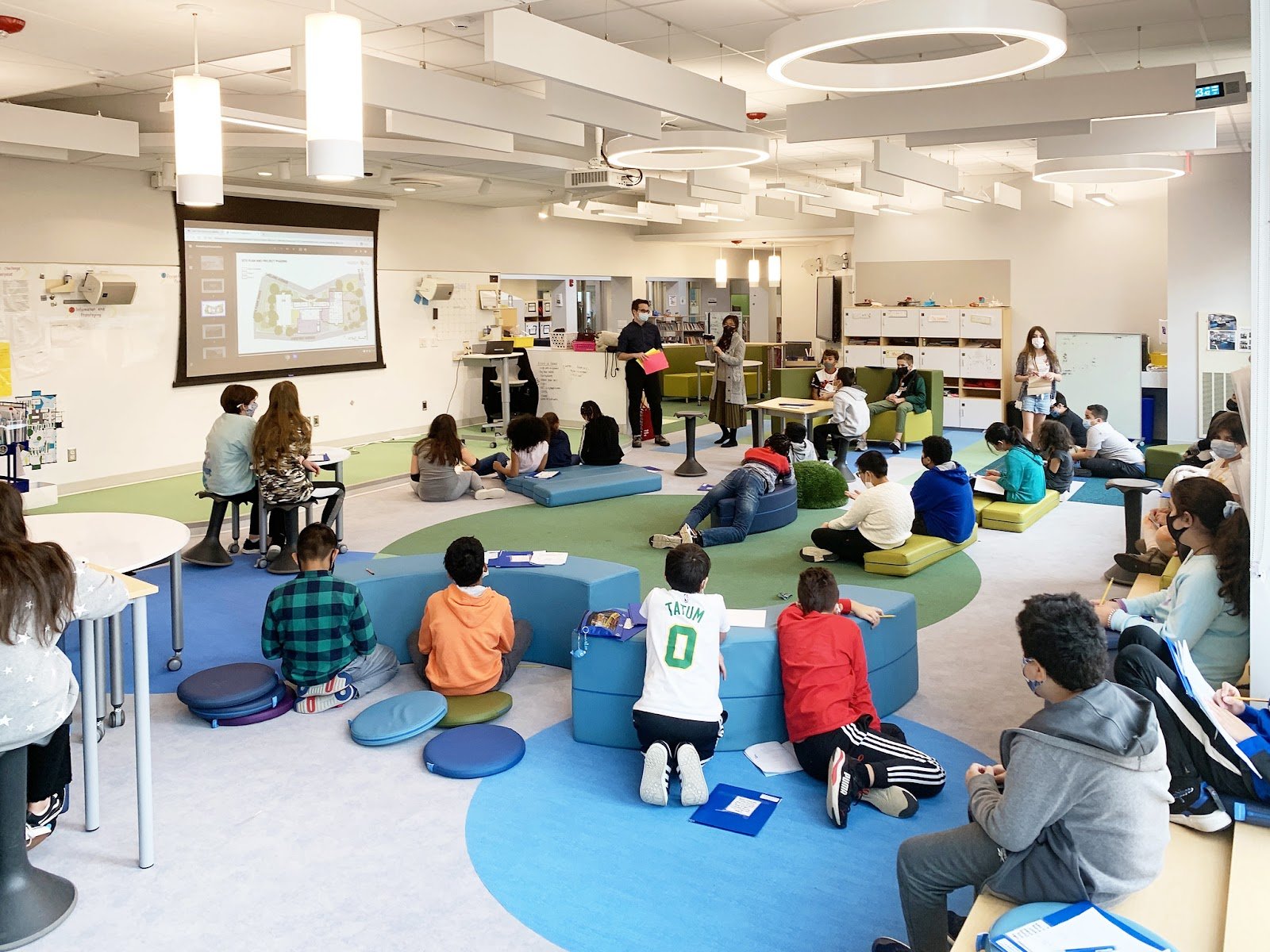
How Many Teachers Can a Building Be?

image from Mike Post at Fielding International

We may be used to the idea that a school building can be a kind of “third teacher,” that—along with their peers and their human educators—shapes what students learn.

But, even when we do think about how much our physical environments can shape our learning experiences, we rarely think about what kind of teacher these buildings are. So, we end up creating buildings that lecture.

What other kinds of teachers might our school buildings be? How else might they shape the learning that happens in them?

Here’s my essay, from the July 2024 issue of Getting Smart.

Your elevator pitch isn’t made of sentences, so stop trying to write it.

David’s marketing team needed to rebuild the elevator pitch for his school’s MBA program. And he was looking for help coming up with a few sentences that’d capture what they did best and why it mattered. The problem, as he saw it, was a writing problem.

But that’s not what an elevator pitch is. It’s not a statement that says something; it’s an action that does something. A pitch is like a play, and it happens in the back-and-forth between one person and another. The words that get said are just props that help one actor get something done with another (a rose to draw them closer, a sword to scare them off). 

So David and I stepped back from the page to think about the drama: who’s trying to make what kind of impact? On whom? What’s their setting? What just happened—and what’s about to? Instead of solving for the sentences, we tried to solve for the interaction

What’s it like? 

When you’re pitching an idea, you’re facing someone who doesn’t understand what you’re talking about. You’re challenging them to make sense of something fundamentally unfamiliar. 

So don’t force them to do a lot of translating. Instead, give them an analogy that's easy to picture, some landmark ideas they can take their bearings from.

David and I came up with this: 

It’s like Duolingo, but instead of learning Portuguese, you’re learning about marketing or finance. And you’re not just learning this content for fun: you’re getting credit that’ll count for your MBA.

The analogy felt pretty clear—but it also got people thinking of an app instead of a grad school. Maybe, in v.2, it’d be better to first compare the school to a brick-and-mortar  university...and then adjust the mental model by focusing on mobile-first. 

Solve a problem. 

Put the idea to work, so people can see it in action—and understand what it’s good for. Show them the job your idea can get done, the change it can make, the problem it solves. Here’s what we sketched out:

Now that most everyone owns a smartphone, we’ve no longer got empty space in our days. We’re waiting for the train, or the tea to boil, or the doctor to see us—and we start scrolling. But mostly we fill in these gaps with stuff that's mindless. 

What if we helped people get real value out of their in-between time? A chance to use those 3 minutes to move a little farther through the course on your phone—and get that much closer to your MBA.

There are a lot of right moves that can help people get your idea. But none of them wins or loses on the page--because success isn’t about getting the sentences right. A pitch matters if the other person keeps nodding while you’re giving it, and then asks for more. If you pitch it, and they catch it.

The Limits of Rapport: What's lost when we focus on connecting to students

connecting students.jpg

As schools turned toward remote learning during the COVID-19 pandemic, they focused on preserving the connections between teachers and their students. But the connections among students are at least as important--and easy to neglect in remote learning. We need to design new ways to deliberately build in to their experience of virtual school the things  our kids used to get around the edges of in-person school.

Read the full article in the summer 2020 issue of Kappan.

Inside Teachers’ Experience of the Pandemic

teachers experience pandemic.png

Partnering with MIT’s Teaching Systems Lab, Big Sky Blue conducted 40 intensive interviews with educators across the country to build a deep, intimate understanding of teachers’ on-the-ground experience—to inform a series of recommendations for school- and system-level leaders. You can read the full report, or explore the interview transcripts to hear teachers talking in their own words.

Dreaming School

I believe that we learn by practice. Whether it means to learn to dance by practicing dancing or to learn to live by practicing living, the principles are the same….One becomes, in some area, an athlete of God.

Martha Graham

athlete of god.jpeg

It is difficult to talk about what schools ought to be in the same words we have learned in the schools we are used to. This old language is tied to ideas and assumptions so familiar that we can hardly think outside them. We take for granted our definitions of student, teacher, and school—as though they were as obvious and fixed as the meaning of a chair or a hammer. To open up our way of thinking about schools, we need to open up the ways we talk about them. And as school leaders, this re-imagination is especially crucial. No matter how small each may be individually, every choice we make—about hiring, or curriculum, or fundraising—remakes our school, and thus constitutes a chance to bring it closer to our dream of what it might someday become.

I dream of a school where students do something much better than what young people typically do in school. I am not interested in building a smooth machine that keeps everyone in it—students, teachers, staff—going through the motions that keep the wheels spinning. I want our students to do real work. Hard work. But in school, hard work too often means meaningless work: many directions to follow, lots of mistakes to avoid. Too much memory and too little mind. A great deal of note-taking and too little sense-making. And love has little to do with any of it. I am aiming for something different: for students to do the kind of work that people do because they have learned to love it—not because they have been made to do it. I want to see students who work so intensely that the world outside the essay or sculpture or experiment before them seems muffled and far away. I want this work to leave them sweaty and exhausted and proud. I want our students to take their work home not because somebody told them that it is homework, but because they cannot leave it behind, because they are not done with it yet. I want their work to be like play, and this play to be like when a real athlete is entirely immersed in her game or a serious musician gets perfectly lost in his music.

I want our students to learn the discipline required to accomplish good work, the care needed to shape brilliant possibilities into precise actuality. At first, this discipline may come from the school’s expectations; ultimately, it must be driven by each student’s understanding of what the work deserves. I want our students to lean toward the challenge of a harder book or a more difficult equation—for the chance it offers to prove that they can do better this time than they did the last: to show that who they are today is not just who they were yesterday.

I see this school in a half-daydream: teachers committed like priests to the gods of their discipline (of physics, or poetry, or architecture); whose devotion, though, does not take them out of the world, but into it: math teachers who see that everything around them is made of numbers, history teachers who know that who we are depends entirely on what happened before we arrived, science teachers who secretly believe that chemistry is the only way to get at what matters most. And their commitment to these disciplines transforms these teachers in the same way that a marathon runner is made thin and swift by her training—and a swimmer, through his “discipline,” grows wide-shouldered and at ease underwater. When I imagine their classrooms, I see teachers wrapped in robes as brilliant as those the monks in Thailand wear, whirling round like dervishes. Outside the doorways lie a pile of robes the same color for students to slip on as they enter (indigo for the poetry room, and scarlet by the door where math happens). The students walk in and soon they are dancing, too, trying out what it is like to give themselves up to a historian’s passion, or to use their body like a painter does. The students leave and drop their robes outside; but maybe the color has rubbed off a little, and when they graduate they’re smeared with crimson and aquamarine: painted like Joseph’s coat from dreaming. Or maybe it is their eyes that sometimes see the world through science-colored lenses, or make historical sense of what just happened. Or maybe it is their ears that hear more keenly the world’s insistent whisper: Watch closely. Figure me out.

Inventing our customers by how we talk to them

Screen Shot 2019-11-17 at 10.49.32 AM.png

“Describe a significant experience, achievement, or risk that you have taken 

and its impact on you.”

Do you remember how it felt to hit that kind of prompt at the top of your college application? Or maybe you don’t need to remember. Maybe you’re like me, and you scan across that sentence, and something clicks inside, and next thing you know you’re in Bullshit Mode. Ok. It’s like that. I’m just here to say what I’m supposed to. You don’t really care what I really think.

I had the same kind of feeling, over and over these past few months, as I talked with my seventeen-year-old about her own college essays. I saw again the way these questions can pull you, like some black hole of bad expectations, into a way of thinking about yourself and what you’ve done. How they set the rules you’ll be playing by: what counts as “significant,” what sorts of risk are right to take, which kinds of impact are worth having.

But it’s not just college essay questions that push around the people they’re pointed at. Every time we start a conversation--especially when we’re the ones asking the questions--we choose the rules by which it’ll run. We make up the role we’ll play and lay out another one for the person we’re talking to. By the words we choose and the way we put them together, we signal the kind of person we are: Excuse me, ma’am, may I trouble you for directions? And we ask the person we’re addressing to be a certain kind of person back. Where can a guy get a drink around here? We let them know who’s got the power, what’s in-bounds and what’s out, how far to go and where to stop. Employees must wash hands. We let them know where they stand in this relationship, and signal what kind of questions they get to ask back. 

In the business world, the voice we choose shapes every touchpoint we create with our customers. There’s look and feel...and also tone—the kind of “person” we present as. The kind of person we invite our customers to be, in response.

I got a call awhile back that solved the problem of voice in exactly the wrong way. A recruiter wanted to get a reference on a former colleague, and though I answered every question she asked, she learned almost nothing from the 20 minutes we spent on the phone.  Partly it was the questions she asked; partly it was the way she responded to my answers; partly it was a million ways she signaled that this would be the kind of conversation you need a jacket and tie to get into—where everybody talks politely and not much gets said. 

It didn’t take long to see where things were heading, maybe as soon as she asked for my assessment of Pam’s capacities for taking initiative. So I was pretty clear on the rules we’d be playing by--the kind of conversation this was supposed to be--by the third time she said perfect in response to whatever I said. Maybe she figured “positive" feedback would encourage me to keep talking. Maybe she thought she was making me feel comfortable. But what I actually felt was ignored: as though she didn’t really want to find out what I really thought, and just wanted to fill the blank under each question on her list. Perfect.

By the time she asked me how I’d characterize the candidate's strengths as an employee, it seemed like I was the only one left in the conversation--like she’d just stepped out for a smoke, and it was just me and a list of questions that’d been passed down from one recruiter to the next, armchairs wrapped in plastic that nobody had ever sat in.

She wanted to know how Pam had interacted with senior executives during situations of significant stress and, for a moment, I remembered Pam telling off one of the VPs who’d asked her to stay late. But then I remembered where I was, and stuffed back my memory into that same place that off-color jokes get put when you look up and remember you’re at your grandma’s. 

Afterwards, I wondered what would’ve happened if the recruiter had opened with a question that showed she truly wanted to hear what I had to say--instead of stock questions that asked for stock answers. If she’d started off with So, what do you think of Pam? It would’ve been harder, I think, not to say at least a little of what I was thinking. Or if she’d hit me with her last question at the very beginning: if you had the chance, would you hire her again? Especially, If she’d asked a little like a bartender asking What’re you drinking? Maybe then I would’ve let myself slip into that moment she wanted me to imagine: when I’m looking at Pam’s resume and trying to decide if she’s the best person I could find for the job.


Back when I was single, a friend told me that brunch was the best place for a first date. The room’s brighter than a bar, there are families around, and it’s early in the day, so there’s no pressure about what’s going to happen afterwards. Conversations work the same way: we invite someone to meet us in a certain type of place, and each comes with a specific set of rules for what can happen there. Stiff and formal; friendly and straightforward--the way we ask our questions makes room for certain kinds of answers, and lets the person we’re asking know what kind of person we’re looking to meet.

Reasons for leading

A serial CEO thinks about why he does it.

design for leadership.png

Trochanter!” Harry said, leaning across the dark wood of the bar where we’d met for lunch. We hadn’t seen each other for a year, so when Harry saw my crutch he wanted to know what I’d done to get it. I told him about the bike, the dark, the last patch of ice at the end of winter, and the light came up in his eyes as he sketched out bones on a napkin to find out where, exactly, I’d broken my hip.

“That was one of my very first projects,” Harry explained. The client was a big healthcare company that saw a market opportunity in designing ways to keep older people from breaking their hips. The tricky part, Harry explained, was testing. They’d developed a prototype you’d wear inside your pants, a pad with a hard shell on the outside that shifted the impact away from the point of your pelvic bone. But you couldn’t go around pushing over older people to see if your new product actually worked. “Cadavers,” he said. “We’d drop them like they were falling.”

Harry used to run the design firm where I’d worked, and then he’d left to help lead another company, and when we met, he was just done with another CEO gig. The non-compete he’d signed was expiring soon, Harry explained, and he was wondering which he wanted more: to keep working as an independent consultant — or to take on another leadership role.

I asked Harry if he thought he’d be able to stay away from the C-suite, if he wouldn’t miss it. I thought he’d say something about creative freedom, or the power to make a real impact. (I didn’t figure Harry would mention status, since I’d seen the nothing-special desk he’d chosen in the middle of our open office, and I’d once heard from a client how he was the only CEO they’d ever met in work boots, while he was building a prototype bank branch out of foamcore.) But the thing that Harry said he’d miss was responsibility.

It seemed like a strange choice. Responsibility is what most of us spend a lot of time trying to avoid. We look at kids on the playground and talk about how lucky they are to have no work that needs to get done; nobody they need to make happy; nowhere they need to get on time.

But Harry was never much for the obvious answer, and he got me thinking about Robert Frost’s poem, “Birches.” The speaker imagines himself a young boy, swinging from branches out into the sky, escaping the ordinary world and all its worries. But no matter how “weary of considerations” he gets, the speaker insists he doesn’t want to get away for good. “Earth’s the right place for love,” he says, not because it’s perfect, but because it’s the only chance we get to make things happen. “I’d like to get away from earth awhile / And then come back to it and begin over.”